
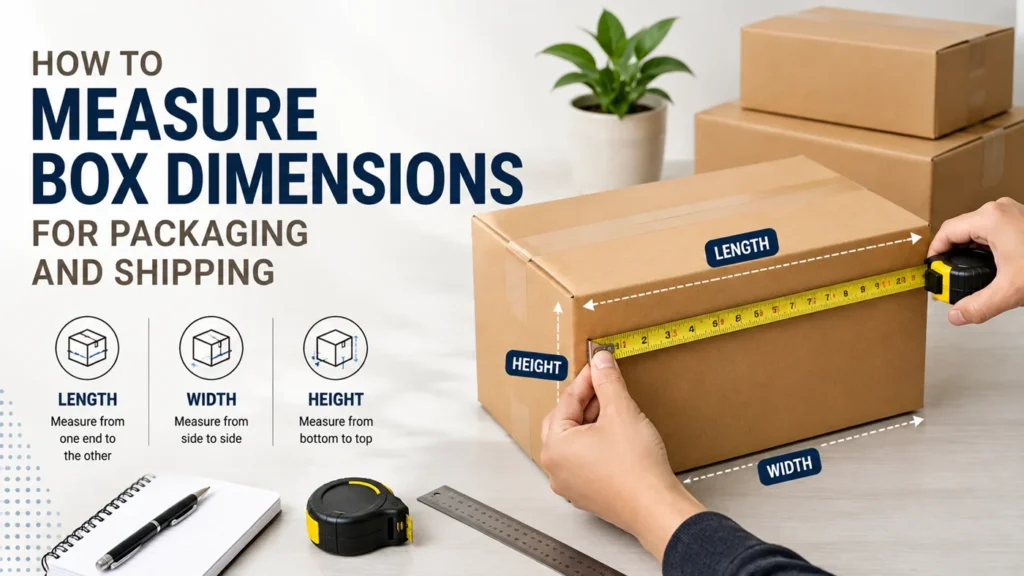
Every custom packaging project begins with one simple step: measuring the product correctly. Accurate box dimensions help you order packaging that fits properly, protects the contents during shipping, reduces material waste, and prevents unnecessary shipping costs.
Whether you’re ordering custom packaging, preparing products for ecommerce fulfillment, or shipping wholesale orders, understanding box dimensions ensures your packaging performs the way it should. Before exploring shipping calculations and dimensional weight, it’s important to learn the correct way to measure both products and boxes.
Understanding the Standard Box Dimension Order
Every packaging manufacturer follows the same measurement sequence:
Length × Width × Height (L × W × H)
Maintaining this order avoids confusion during production and helps ensure your packaging is manufactured exactly as intended.
- Length is the longest side of the opening.
- Width is the shorter side of the opening.
- Height is measured from the base to the top of the box after assembly.
For example:
10″ × 8″ × 4″
means:
- Length = 10 inches
- Width = 8 inches
- Height = 4 inches
Keeping measurements in the correct order prevents production mistakes and allows packaging suppliers to recommend the most suitable box style for your product.
Tools You Need to Measure Box Dimensions
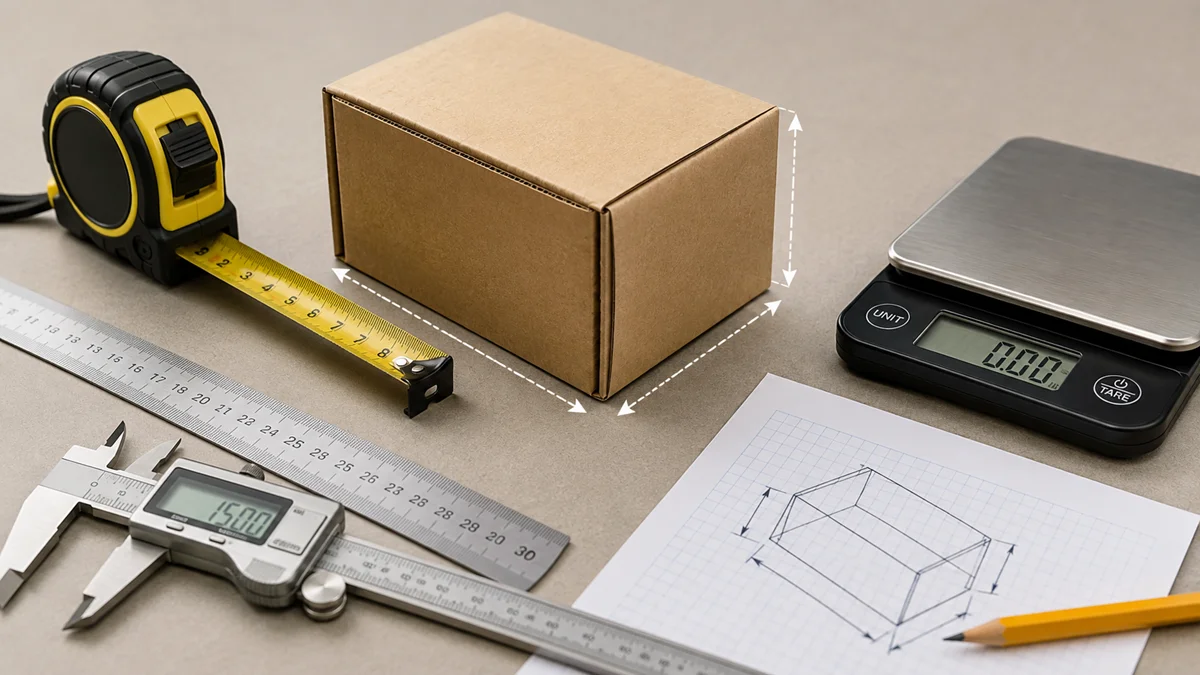
You don’t need specialized equipment to take accurate measurements. Most businesses can measure products and packaging using simple tools.
Recommended measuring tools include:
- Metal ruler
- Measuring tape
- Digital caliper (for small products)
- Straight edge
- Notebook or digital spreadsheet for recording dimensions
Always measure on a flat, level surface and record every measurement using the same unit, whether inches or centimeters. Switching between units without converting accurately often leads to manufacturing errors.
How to Measure Your Product Before Ordering Custom Packaging
Before measuring the box, measure the product itself.
Manufacturers build packaging around the product not the other way around.
Follow these simple steps.
Step 1 Measure the Longest Side
Place the product on a flat surface.
Measure the longest side from one end to the other.
This becomes the length.
If your product is irregularly shaped, measure the point that extends the furthest.
Step 2 Measure the Shorter Side
Without changing the product’s position, measure the shorter side across the product.
This becomes the width.
Length is always greater than or equal to width.
Step 3 Measure the Vertical Height
Measure from the base of the product to its highest point.
This becomes the height.
If decorative pieces, caps, handles, lids, or closures extend above the product, include them in the total height.
Ignoring these small details often results in packaging that cannot close properly.
Why Inside Box Dimensions Matter More Than Outside Dimensions
One of the biggest mistakes businesses make is measuring only the outside of an existing box.
Packaging manufacturers almost always request inside dimensions because these measurements determine whether your product fits correctly.
The inside dimensions describe the usable space available after the box is folded and assembled.
Outside dimensions vary depending on:
- Board thickness
- Paperboard type
- Corrugated flute profile
- Folding style
- Manufacturing tolerances
For example, two boxes may have identical outside measurements but different inside capacities because one is manufactured using thicker corrugated material.
When requesting custom packaging, always provide the inside dimensions unless your supplier specifically requests otherwise.
Why Your Product Should Never Match the Box Exactly?
A common misconception is that the product and the box should have identical measurements.
In reality, products require clearance so they can be inserted and removed without force.
Imagine your product measures:
8″ × 6″ × 3″
Ordering a box with exactly the same inside dimensions can create problems because packaging materials have thickness, folded corners, glue joints, and manufacturing tolerances.
Instead, packaging designers usually recommend adding a small amount of clearance based on the product type.
The ideal clearance depends on several factors, including:
- Product weight
- Product fragility
- Packaging material
- Protective inserts
- Assembly method
Products with delicate finishes generally require additional space for protective cushioning, while rigid products may require only minimal clearance.
Rather than guessing, discuss the recommended internal clearance with your packaging supplier before production begins.
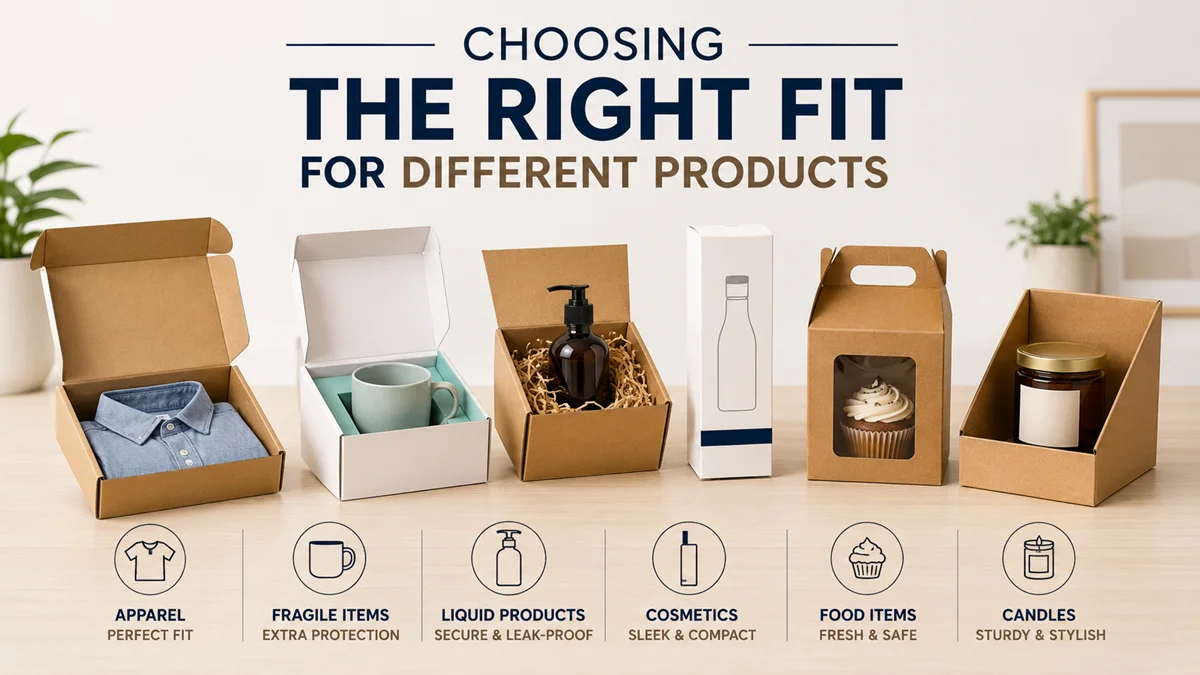
Choosing the Right Fit for Different Products
Not every product requires the same packaging tolerance.
For example:
Electronics often require space for foam inserts.
Glass bottles may require partitions or molded inserts.
Luxury products frequently include presentation trays.
Retail cosmetics may require snug packaging to improve shelf presentation.
Food products sometimes require space for protective wrapping before they are placed inside the box.
Because of these differences, packaging engineers rarely recommend one universal clearance for every product.
Instead, they evaluate how the product will be packed, displayed, shipped, and opened before determining the final inside dimensions.
How Packaging Manufacturers Use Your Measurements?
Once your dimensions are finalized, packaging manufacturers use them to create the structural design of your box.
These measurements influence nearly every production step, including:
- Structural engineering
- Die-line development
- Material optimization
- Printing layout
- Folding pattern
- Glue placement
- Shipping efficiency
Even a small measurement error can affect the final packaging structure.
For example, increasing the height by only a few millimeters may change the position of fold lines or alter how the closure mechanism functions.
Accurate dimensions also help manufacturers recommend packaging styles that best suit your product.
Depending on your product size and application, they may recommend structures such as Mailer Boxes for ecommerce shipments, Product Boxes for retail display, or specialty folding cartons designed around your specific dimensions.
Material selection is also influenced by measurements. Larger or heavier products often require stronger substrates such as Cardboard Boxes, Kraft Boxes, Rigid Boxes, or Corrugated Boxes, each offering different levels of durability, print quality, and protection.
Understanding these fundamentals makes it much easier to communicate with your packaging supplier and reduces the likelihood of production revisions later in the project.
Measure an Assembled Box the Right Way for Shipping
Once your packaging has been produced, measurements are taken differently than when designing a custom box. Shipping carriers use the outside dimensions of a fully assembled box because those measurements determine how much space the package occupies during transportation.
Before measuring:
- Close the top and bottom flaps completely.
- Assemble the box exactly as it will be shipped.
- Place it on a flat surface.
Then measure in the standard order:
Measure the Length
Identify the longest side of the box opening.
Measure from one outside edge to the opposite outside edge.
Record this as the length.
Measure the Width
Turn the measuring tape 90 degrees and measure the shorter side of the opening.
Record this as the width.
Measure the Height
Measure vertically from the bottom of the box to the highest point after the flaps are fully closed.
Your final shipping dimensions should always follow the format:
Length × Width × Height (L × W × H)
Using a consistent measurement method helps prevent shipping disputes and ensures carriers calculate transportation charges correctly.
How to Measure Different Box Shapes
Not every package is a standard rectangular carton. Many industries use specialty packaging styles that require different measuring methods.
Understanding these variations helps when requesting custom packaging or calculating shipping space.
Measuring Round Boxes
Round packaging is commonly used for candles, cosmetics, gift items, apparel accessories, and premium food products.
Unlike rectangular cartons, round boxes are measured using only two dimensions:
Diameter × Height
To measure:
- Measure straight across the circular opening to find the diameter.
- Measure vertically from the base to the top to determine the height.
Example:
6″ × 10″
This means the box has a 6-inch diameter and a 10-inch height.
Measuring Square Boxes
Square boxes are the simplest to measure because all four sides are equal.
Measure:
- One side of the opening
- The vertical height
Example:
8″ × 8″ × 5″
Since length and width are identical, only one horizontal measurement is needed before recording the height.
Measuring Tall or Irregular Products
Products with handles, pumps, decorative lids, or unusual shapes require extra attention.
Measure the furthest point on every side.
Never ignore:
- Caps
- Handles
- Nozzles
- Decorative tops
- Attached accessories
These features affect both packaging design and shipping dimensions.
Common Box Dimension Abbreviations You Should Know
Packaging manufacturers, designers, and shipping carriers often use abbreviations when discussing box sizes and shipping specifications. Understanding these common terms helps you communicate your packaging requirements more accurately and reduces the chances of production or shipping misunderstandings.
| Abbreviation | Meaning | Example |
| L | Length | Longest side of the box opening |
| W | Width | Shorter side of the box opening |
| H | Height | Vertical distance from the base to the top |
| L × W × H | Standard box dimension format | 12″ × 8″ × 4″ |
| D | Diameter (Round Boxes) | 6″ Diameter |
| ID | Inside Dimensions | Internal usable space |
| OD | Outside Dimensions | Finished external box size |
| DIM Weight | Dimensional Weight | Shipping weight based on package volume |
Whenever you request a quotation or approve production artwork, confirming these abbreviations with your packaging supplier helps ensure everyone is working from the same specifications.
Box Dimension Examples for Popular Packaging Styles
Although most packaging follows the standard Length × Width × Height format, certain box styles require different measurement methods. The table below provides a quick reference for several commonly used packaging styles.
| Packaging Style | Measurement Format | Example |
| Product Box | L × W × H | 6″ × 4″ × 2″ |
| Mailer Box | L × W × H | 10″ × 8″ × 3″ |
| Shipping Box | L × W × H | 16″ × 12″ × 10″ |
| Folding Carton | L × W × H | 8″ × 5″ × 2″ |
| Rigid Box | L × W × H | 9″ × 7″ × 3″ |
| Round Box | Diameter × Height | 5″ × 8″ |
| Square Box | L × W × H | 8″ × 8″ × 5″ |
Before requesting a quotation or approving a packaging design, confirm whether your manufacturer requires inside or outside dimensions. Sharing the correct measurements from the beginning reduces revisions, speeds up production, and helps ensure your finished packaging fits and performs exactly as intended.
Calculate Box Volume
Knowing the total volume of a box helps estimate storage capacity, shipping efficiency, warehouse utilization, and packaging requirements.
The standard formula is:
Length × Width × Height
Example:
Length = 12″
Width = 8″
Height = 5″
Volume:
12 × 8 × 5 = 480 cubic inches
Manufacturers often use this calculation when designing shipping cartons or determining how many products fit inside a master case.
Volume calculations are also useful when estimating pallet configurations, warehouse storage capacity, and the number of products that can fit inside larger shipping cartons.
Understanding Dimensional Weight
Shipping companies don’t always charge based only on actual weight.
Large lightweight packages occupy valuable cargo space even if they don’t weigh much.
For this reason, carriers use dimensional weight (DIM weight).
Dimensional weight estimates how much shipping space a package consumes.
Most carriers compare:
- Actual package weight
- Dimensional weight
The higher value becomes the billable shipping weight.
This pricing method encourages businesses to avoid oversized packaging that wastes transportation space.
How Dimensional Weight Is Calculated
The general formula is:
(Length × Width × Height) ÷ DIM Divisor
For example:
Box dimensions:
20″ × 16″ × 12″
Volume:
20 × 16 × 12 = 3,840 cubic inches
If the carrier uses a divisor of 139:
3,840 ÷ 139 ≈ 27.6 lbs
If the actual package weighs only 18 lbs, shipping charges will typically be based on approximately 28 lbs because the dimensional weight is higher.
Always verify the latest DIM rules with your shipping carrier because formulas and pricing policies may change over time.
Major carriers such as UPS, FedEx, and DHL publish their dimensional weight guidelines and shipping calculators on their official websites. Because DIM divisors and pricing policies can change over time, businesses should always verify the latest shipping guidelines before calculating freight costs.
Common Mistakes When Measuring Box Dimensions
Many packaging problems originate from simple measuring errors.
Avoid these common mistakes:
Measuring the Outside Instead of the Inside
When ordering custom packaging, manufacturers usually need inside dimensions, not outside measurements.
Recording Measurements in the Wrong Order
Always use:
Length × Width × Height
Switching the order can result in incorrectly manufactured boxes.
Forgetting Protective Inserts
Foam inserts, partitions, molded trays, or paper cushioning require additional internal space.
Include these components before finalizing box dimensions.
Ignoring Material Thickness
Corrugated board, rigid board, and folding carton materials have different thicknesses that affect usable interior space.
Mixing Measurement Units
Do not combine inches and centimeters within the same project.
Choose one measurement system and use it consistently throughout production.
Best Practices Before Sending Dimensions to Your Packaging Supplier
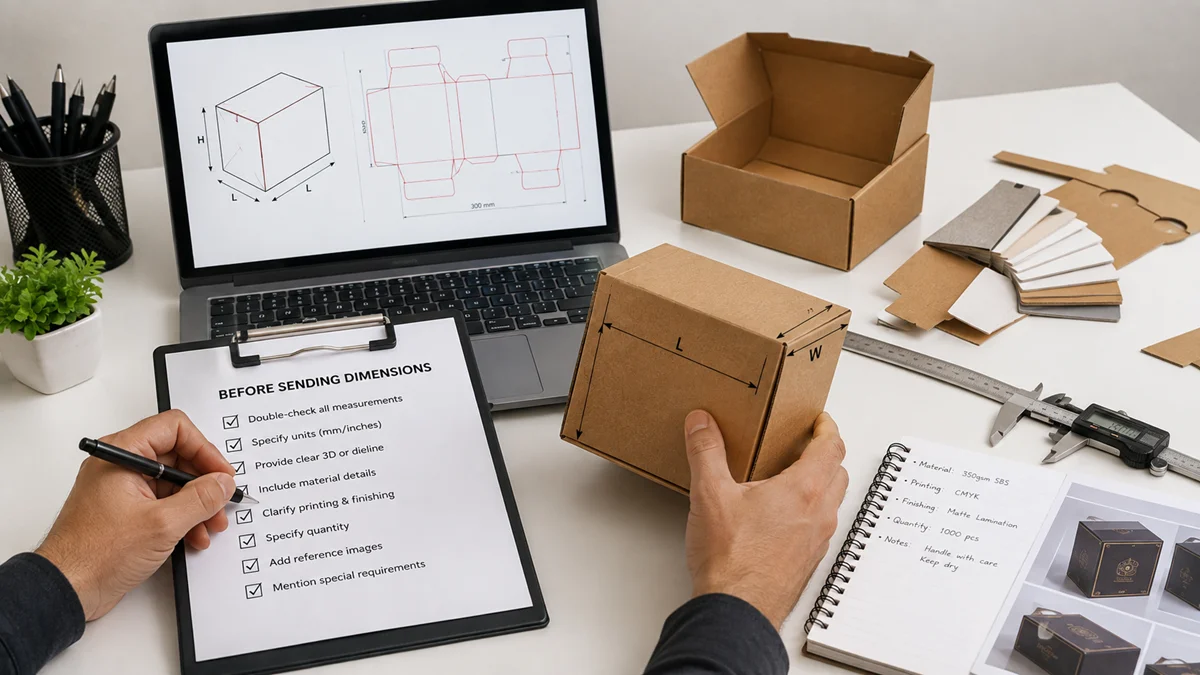
Even accurate measurements should be verified before they’re submitted to your packaging supplier. Reviewing your dimensions one final time helps prevent production delays, unnecessary revisions, and packaging that doesn’t fit your products properly. A simple pre-production checklist can save both time and manufacturing costs.
Before submitting your box dimensions, remember to:
- Measure your product more than once to confirm accuracy.
- Record dimensions in the standard Length × Width × Height (L × W × H) order.
- Specify whether you’re providing inside or outside dimensions.
- Include protective inserts, wrapping, or accessories that will be packed with the product.
- Measure assembled shipping boxes with all flaps fully closed.
- Use one unit of measurement throughout the project, such as inches or centimeters.
- Share product photos or samples when ordering custom packaging for products with unusual shapes or special presentation requirements.
- Double-check whether your dimensions should be rounded to the nearest fraction of an inch, millimeter, or centimeter based on your packaging supplier’s production requirements.
Providing complete and accurate information allows packaging manufacturers to recommend suitable materials, box styles, and structural designs while reducing the likelihood of production changes later in the project.
Why Accurate Box Dimensions Save Money
Accurate measurements improve much more than packaging fit.
They help businesses:
- Reduce shipping costs
- Minimize material waste
- Prevent damaged products
- Improve warehouse efficiency
- Speed up packing operations
- Reduce packaging redesigns
- Create a better customer unboxing experience
Even small measurement improvements can produce meaningful savings across large production runs and recurring shipments.
Final Thoughts
Learning how to measure box dimensions correctly helps you make better packaging decisions from the very beginning of a project. Whether you’re ordering custom packaging, comparing box sizes, planning warehouse storage, or preparing shipments, accurate measurements reduce production errors and unnecessary shipping expenses.
Measuring products first, understanding the difference between inside and outside dimensions, following the standard Length × Width × Height format, and accounting for packaging materials all contribute to packaging that fits properly and performs reliably throughout the supply chain.
Working with an experienced packaging manufacturer also makes the process easier. Once accurate dimensions are provided, structural designers can recommend the most suitable packaging style, material, and construction for your product while helping you avoid costly revisions later.