
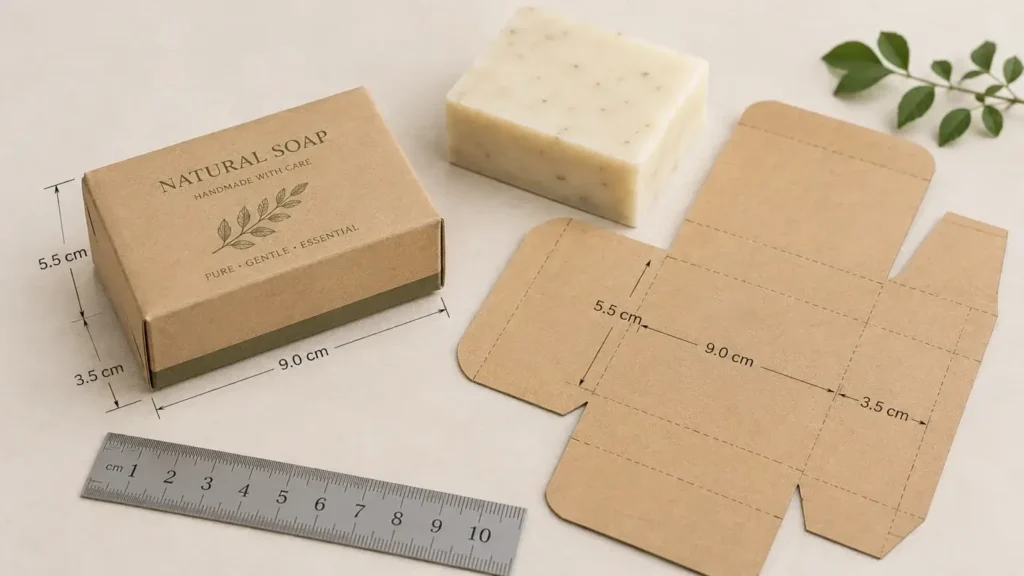
Soap box dimensions do not follow one universal standard. A common reference size for a rectangular retail bar is 3.75 × 2.5 × 1.25 inches, but the correct production size should always come from the cured, wrapped, and ready-to-pack soap.
Soap shape, wrapping thickness, paperboard material, carton structure, inserts, and manufacturing tolerances can all affect the final measurements. An assembled blank sample should confirm the fit before printing and full production begin.
Standard soap box dimensions by product type
The following measurements provide practical starting points. Each figure represents an approximate internal box size and should be checked against the finished product.
| Soap format | Approximate internal size in inches | Approximate size in millimeters | Typical use |
| Guest or travel soap | 2.25 × 1.75 × 1 | 57 × 44 × 25 | Hotels, samples, and travel products |
| Standard retail bar | 3.75 × 2.5 × 1.25 | 95 × 64 × 32 | Everyday rectangular soap bars |
| Handmade soap bar | 4 × 2.75 × 1.5 | 102 × 70 × 38 | Artisan and hand-cut soaps |
| Large or luxury bar | 4.25 × 3 × 1.75 | 108 × 76 × 44 | Thick bars and premium presentation |
| Round or oval soap | Custom measurement | Custom measurement | Specialty and decorative soaps |
| Two-bar or gift set | Custom measurement | Custom measurement | Gift boxes and subscription sets |
Millimeter values are rounded planning conversions. A packaging manufacturer should confirm the final internal and external dimensions before production.
Soap weight alone cannot determine box size. Two four-ounce bars may use different molds, densities, or decorative shapes, so the finished product should guide the packaging dimensions.
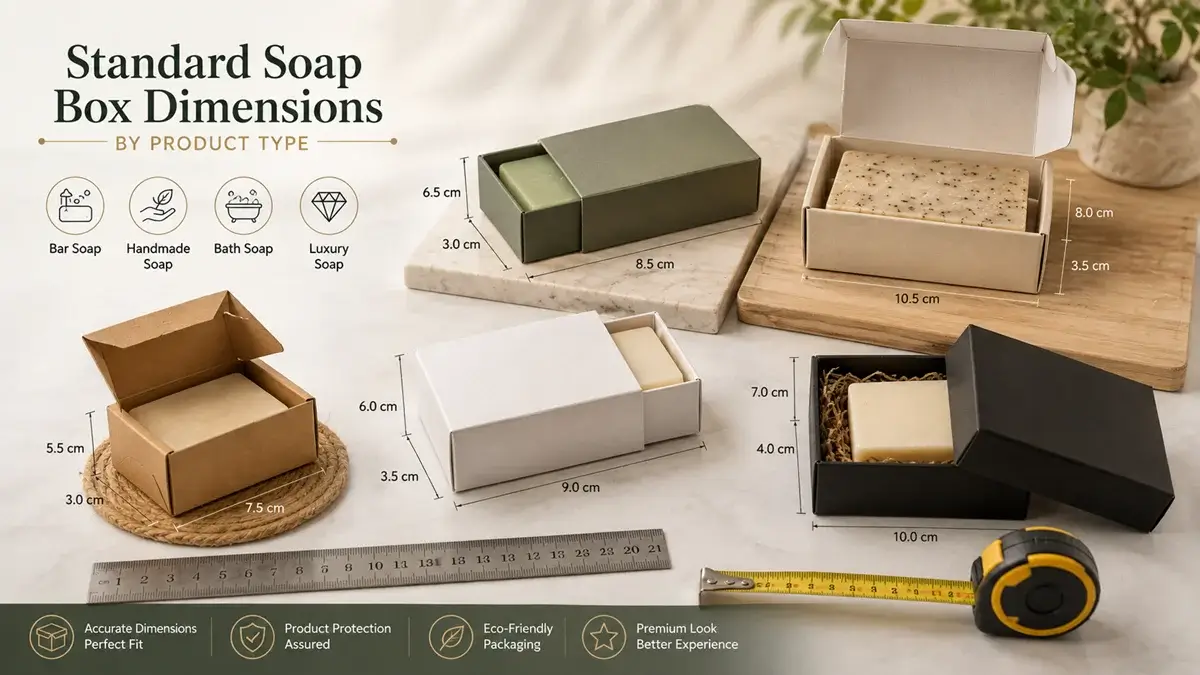
Read soap box measurements in the correct order
Packaging measurements are normally written as:
Length × Width × Depth
Length is the longest side, width is the shorter adjacent side, and depth is the thickness from the base to the top. A bar measuring 3.5 inches long, 2.25 inches wide, and 1 inch thick should be recorded as 3.5 × 2.25 × 1 inches.
Round soaps should be measured across their widest diameter and thickest point. Oval soaps require maximum length, width, and depth measurements. Raised logos, textured tops, and uneven edges should also be included.
Some suppliers use height instead of depth, so confirm their terminology before approving a dieline.
Measure the finished soap before choosing a box
Handmade soap can shrink as moisture leaves during curing. Measurements taken immediately after cutting may result in a loose package once the soap reaches its final size.
Measure the soap after curing and after applying the intended wrapper, label, paper band, or liner. Several bars from the same batch should be checked because hand cutting, textured molds, and natural curing can create small variations.
Use this process:
- Allow the soap to complete its normal curing period.
- Apply the wrapper used in the finished package.
- Measure the longest side as length.
- Measure the adjacent side as width.
- Measure the thickest point as depth.
- Check several bars and test the largest practical size inside an assembled blank carton.
Brands ordering Custom Soap Boxes should provide a finished product sample whenever possible. A physical sample helps the manufacturer evaluate fit, wrapper thickness, and closure performance.
Separate product internal and external dimensions
Product dimensions describe the finished soap with its wrapper. Internal dimensions describe the usable space inside the assembled carton. External dimensions include paperboard thickness, folds, glue seams, and the complete structure.
A carton listed as 3.75 × 2.5 × 1.25 inches externally will provide less usable space inside.
Buyers should confirm which measurement type appears on the quotation. Confusing product, internal, and external dimensions can result in tight closures, damaged soap edges, or less usable space than expected.
Allow space for wrapping and production variation
A carton manufactured at exactly the same dimensions as the soap may become too tight after folding. Board thickness, score placement, wrapper material, packing speed, and production tolerance can all affect the fit.
Excessive clearance allows movement, weakens presentation, wastes material, and occupies unnecessary storage space.
No single clearance works for every soap box. Fit allowance should reflect the soap texture, wrapping thickness, board material, carton style, and closure design.
A wrapped bar measuring 3.5 × 2.25 × 1 inches may fit a box close to 3.75 × 2.5 × 1.25 inches, but that reference should not be applied automatically. A thick wrapper, insert, textured surface, or different structure may require another size.
Tuck-end cartons need room for panels and flaps to close correctly. Sleeves require controlled friction. Soap Boxes with Windows need enough paperboard around the opening to maintain panel strength.
Account for different soap packaging formats
Rectangular retail soaps commonly use tuck-end folding cartons. Handmade bars may need additional depth because of thick cuts or textured tops.
Round and oval soaps require measurements across their widest points. Decorative or multi-bar soaps may need trays, inserts, or dividers.
Soap sleeves depend on a close fit, and window cartons need careful opening placement. Select the packaging structure before finalizing dimensions because the same soap may require different measurements in a sleeve, tuck carton, tray, or gift set.
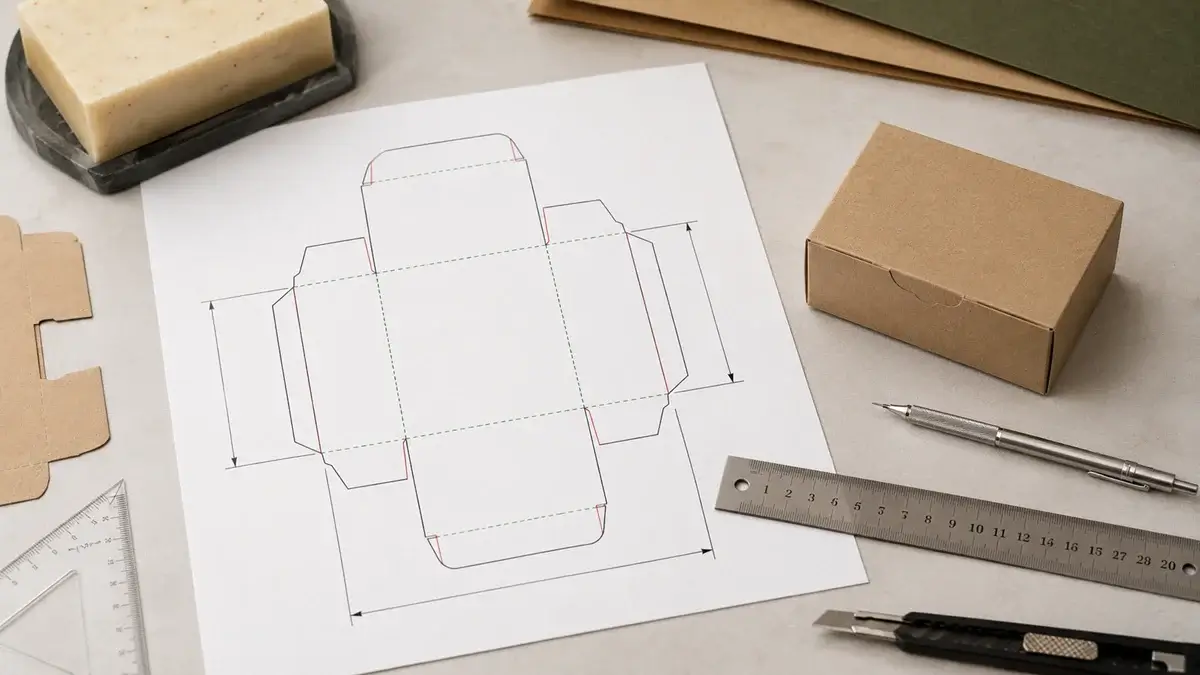
Turn the approved size into a soap box dieline
A dieline converts approved dimensions into a flat template with cut lines, score lines, glue tabs, closure panels, and artwork areas.
Designers should use the manufacturer-issued dieline rather than a generic online template. Important text, logos, and barcodes should remain inside the designated safe areas.
A digital rendering can preview appearance but cannot confirm fit. Test an assembled blank with the actual soap to check insertion, removal, flap closure, window placement, wrapper protection, and insert performance.
Consider storage and shipping requirements
Accurate retail dimensions support display, storage, handling, and efficient master case packing.
Retail soap boxes do not replace protective shipping packaging. Ecommerce orders may use Corrugated Mailer Boxes around the retail carton, while wholesale shipments usually require master cases arranged around multiple units. Consider the intended case quantity before approving the final retail size.
Avoid common soap box sizing mistakes
- Measuring the soap too early
Fresh soap may shrink during curing. Measure production-ready bars instead of freshly cut products. - Ignoring the final wrapper
Paper wraps, labels, bands, and liners add thickness. Include every finished layer in the measurements. - Choosing a box by weight alone
A four-ounce label describes mass rather than physical size. Mold design, density, and cutting method determine the required space. - Skipping the physical sample
A digital mockup cannot reveal friction, flap pressure, or insert problems. Confirm the fit with an assembled blank before printing.
Conclusion
Accurate soap box dimensions begin with the cured and wrapped product rather than a generic chart. Brands should measure several finished bars, confirm the dimension order, separate internal and external measurements, and account for inserts, windows, and carton construction.
Standard measurements such as 3.75 × 2.5 × 1.25 inches can support early planning, but they should not replace physical testing. Soap shape, wrapper thickness, board material, fit allowance, and production tolerance can all change the final size.
Instant Boxes Hub can review your soap measurements, packaging structure, window requirements, inserts, and presentation needs. Share the finished product dimensions or a physical sample to request a quote based on the soap you plan to pack.