

A standard cigarette pack contains 20 cigarettes in the United States and many other countries. Although this quantity has become the global benchmark, it is not a universal rule. Some markets sell packs containing 10, 25, 26, or 30 cigarettes because packaging regulations, taxation policies, consumer purchasing habits, and regional manufacturing standards vary from one country to another. Understanding these differences requires looking beyond the number printed on the pack and examining how cigarette packaging is designed, produced, and distributed.
The number of cigarettes inside a pack influences much more than retail pricing. Pack quantity affects box dimensions, material selection, production efficiency, transportation, shelf presentation, and regulatory compliance. Manufacturers carefully determine these specifications before production begins to ensure the packaging protects the product, meets legal requirements, and performs consistently throughout the supply chain. This guide explains why 20 cigarettes became the industry standard, how pack sizes vary worldwide, and how packaging supports every stage of a cigarette product’s journey.
Why 20 cigarettes became the industry standard?
Twenty cigarettes became the most common pack size because it created a practical balance between manufacturing efficiency, retail convenience, and consumer demand. Producing millions of identical packs with consistent dimensions simplifies printing, die-cutting, filling, wrapping, and transportation while allowing retailers to organize inventory more efficiently. Standardization also helps manufacturers maintain production consistency across different facilities and distribution networks.
The 20-cigarette format also became widely accepted because it provides predictable packaging dimensions. Consistent pack sizes simplify carton production, pallet loading, warehouse storage, and retail merchandising while reducing unnecessary packaging variations. Although regulations have changed in many countries over time, the 20-cigarette configuration remains the benchmark against which most other pack sizes are developed.
Why cigarette pack sizes differ between countries?
Although many countries use the same standard pack size, packaging regulations and market conditions vary considerably across the world. Governments establish rules regarding minimum pack quantities, health-warning requirements, and branding restrictions, while manufacturers adjust packaging to comply with those regulations without disrupting production efficiency. As a result, identical cigarette brands may be sold in different pack formats depending on the destination market.

Government regulations
Public health legislation is one of the primary reasons cigarette pack sizes differ internationally. Some countries regulate minimum pack quantities to discourage low-cost purchases, while others require standardized warning labels or plain packaging that directly influence the layout and dimensions of the finished pack. Packaging manufacturers, therefore, design cigarette cartons according to both structural requirements and regional compliance standards before production begins.
Consumer demand and regional markets
Consumer purchasing habits also influence the quantity of cigarettes included in each pack. Markets where affordability plays a larger role may offer alternative pack sizes, while regions with established purchasing patterns often continue using the traditional 20-cigarette configuration. Manufacturers study local demand carefully because changing pack sizes affects production planning, inventory management, and packaging costs throughout the supply chain.
Pack, carton, and shipping case explained
The terms pack, carton, and shipping case are often used interchangeably, even though they describe different stages of the packaging system. A cigarette pack is the individual consumer package purchased from a retailer. A carton groups multiple packs together for retail sale or wholesale distribution, while a shipping case protects multiple cartons during warehouse handling and transportation.
A standard cigarette carton typically contains 10 packs, resulting in 200 cigarettes when each pack contains the standard 20 cigarettes. Shipping cases may hold several cartons depending on the manufacturer’s logistics requirements, warehouse operations, and distribution methods. Designing each packaging level separately helps improve handling efficiency while protecting products from production through final retail delivery.
Common cigarette packaging styles
The structure of a cigarette pack is selected according to how the product will be manufactured, transported, displayed, and used by the consumer. Each packaging style provides different levels of protection, production efficiency, and convenience, making the structural design just as important as the number of cigarettes inside the pack. Manufacturers evaluate these factors during product development to ensure the finished packaging performs consistently throughout its lifecycle.
Before comparing the different styles, it is important to understand that no single structure is suitable for every product or market.
- Flip-top packs: Flip-top packs remain the most widely used cigarette packaging style because the hinged lid allows repeated opening while helping the pack retain its shape. The rigid construction protects cigarettes during transportation and daily handling, making it suitable for products that require dependable structural performance.
- Soft packs: Soft packs are manufactured from flexible paper-based materials that reduce material usage and create a lighter package. While they are easier to compress and carry, they provide less resistance to crushing than rigid constructions and are generally chosen where flexibility is preferred over maximum protection.
- Slide-and-shell packs: Slide-and-shell designs use an outer sleeve and an inner tray that slides open to access the product. Premium brands often select this structure because it creates a distinctive opening experience while providing excellent product protection throughout storage and distribution.
- Tuck-end packs: Tuck-end packaging secures the contents with folding flaps that lock into place during assembly. The structure is straightforward to manufacture, supports efficient production, and provides reliable product containment during transportation and retail handling.
How pack size influences cigarette packaging
Changing the number of cigarettes inside a pack affects far more than the overall dimensions of the box. Internal clearances, board thickness, folding allowances, and structural strength must all be recalculated to ensure the finished package protects the product without creating unnecessary empty space. Even small dimensional changes influence production tooling, print layouts, and carton assembly.
These structural calculations become increasingly important when manufacturers produce multiple pack configurations for different countries. Packaging engineers develop each format around its own specifications to maintain production consistency while ensuring every pack performs efficiently throughout storage, shipping, and retail display. These same engineering principles are applied when manufacturing Cardboard Cigarette Boxes, where accurate dimensions, suitable board selection, and structural precision determine how effectively the finished packaging performs.

Materials used for cigarette packaging
Material selection influences product protection, printing quality, and production efficiency throughout the packaging process. Most cigarette packs are manufactured from premium paperboard because it provides a smooth printing surface while maintaining sufficient rigidity for retail handling. Stronger cardboard constructions may also be used for cartons and secondary packaging that require additional compression strength during transportation and warehouse storage.
Selecting the correct material begins with understanding how the packaging will be used rather than choosing the heaviest board available.
- Paperboard: Premium paperboard produces sharp graphics, consistent colour reproduction, and precise folding performance, making it the preferred material for individual cigarette packs where branding is important.
- Cardboard: Cardboard provides greater structural strength for cartons that experience stacking pressure during storage and distribution. Its durability helps maintain carton integrity throughout logistics operations.
- Protective wrapping: Transparent overwrap film provides an additional barrier against dust, moisture, and everyday handling while helping preserve product freshness and maintain the appearance of the finished package.
How cigarette packaging is manufactured
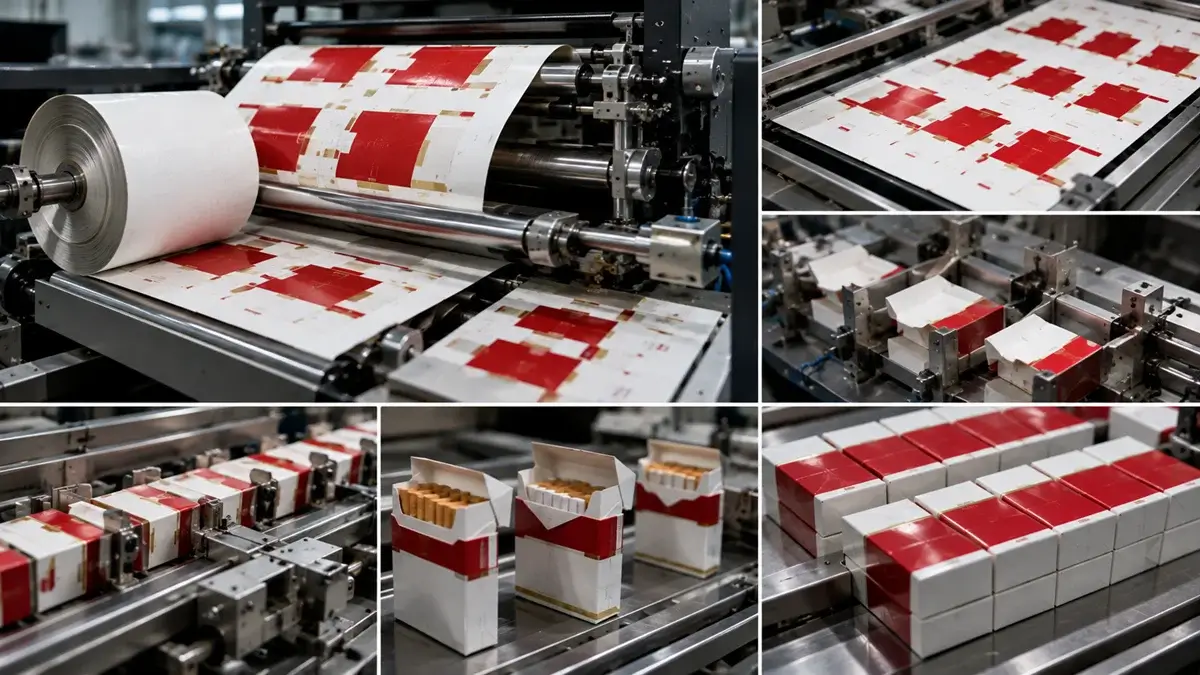
Modern cigarette packaging follows a carefully controlled production process to maintain dimensional accuracy and consistent product quality. Packaging development begins with structural planning, where engineers determine the correct dimensions, board specifications, and folding pattern according to the required pack configuration. Once approved, a dieline is created to define every cut, fold, and glue area before printing begins.
After printing, sheets move through die-cutting, folding, and gluing operations to form the finished pack. Quality inspections are performed throughout production to verify print registration, structural accuracy, folding consistency, and overall appearance before the packaging is filled, wrapped, and prepared for distribution. Maintaining these production standards helps manufacturers deliver custom packaging that performs reliably from the production line to the retail shelf.
Packaging regulations that influence cigarette boxes
Cigarette packaging is among the most highly regulated forms of consumer packaging. Manufacturers must comply with country-specific requirements covering health warnings, mandatory product information, plain-packaging legislation, and branding restrictions before production can begin. These regulations influence not only the artwork but also the structural layout, printable area, and dimensions of the finished package.
Packaging requirements also vary between markets. Some countries specify minimum pack quantities, while others require larger health warnings or standardized colours that reduce the space available for branding. Reviewing regulatory requirements during the structural planning stage helps manufacturers minimize production revisions while ensuring every package complies with the laws of its intended market.
Final packaging insight
Knowing how many cigarettes come in a pack provides only part of the answer. Pack quantity, structural design, packaging materials, production methods, and regulatory requirements all work together to determine how cigarette products are manufactured, protected, transported, and displayed. Understanding these packaging principles helps explain why cigarette boxes differ across markets and why careful structural planning remains an essential part of modern packaging manufacturing.